Altaviva™ Therapy
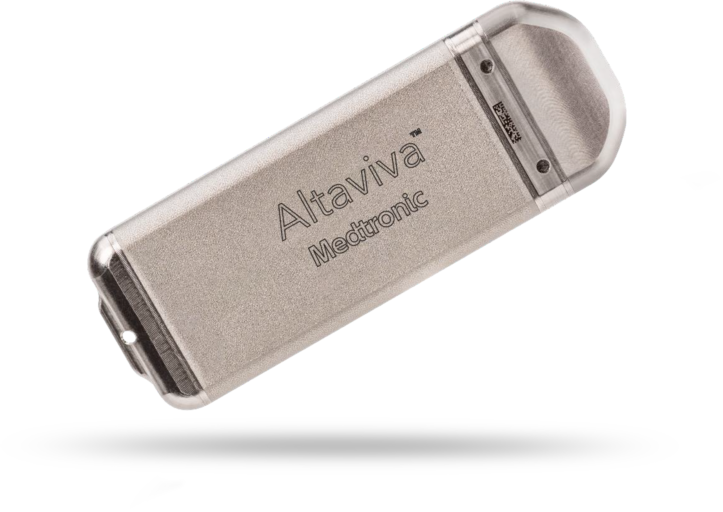
Discover Altaviva™ therapy
The Altaviva™ implant is your convenient and hopeful next step, with automatic therapy delivery that can integrate seamlessly into your life—designed to keep you moving forward, wherever your
journey leads. Unlike medications or injections that target bladder muscles, the Altaviva™ implant for urge urinary incontinence (UUI) targets the tibial nerve that helps control normal bladder function.1,2

How does it work?
- A small device is placed under the skin near the ankle and sends electrical pulses to the tibial nerve that is important in maintaining normal bladder function.1,2
- These pulses may help restore the communication pathways between the bladder and brain,1,2 which may help reduce urgency with leaks.3
- This treatment is called tibial neuromodulation, a proven therapy for reducing bladder control symptoms.3,4-8
A single procedure may help improve your quality of life:
- Implanted in a single, outpatient procedure that lets you go home the same day
- Same-day therapy activation9
- MRI-ready from the start for full-body 1.5T or 3T scans*,10
- Long-lasting battery – designed to deliver up to 15 years of treatment†
For more information, visit www.Medtronic.com/Altaviva
In addition to risks related to surgery, complications can include pain at the implant site, lower leg pain, infection, and/or technical or device problems. Results vary. Talk to your doctor to see if the Altaviva™ system is right for you.
*MRI compatibility is subject to certain conditions. See approved labeling for details.
† Based on clinical and bench testing for expected therapy settings
1. Li X, Li X, Liao L. Mechanism of action of tibial nerve stimulation in the treatment of lower urinary tract dysfunction. Neuromod. 2023;27:256–266.
2. Bhide AA, Tailor V, Fernando R, Vik K, Digesu GA. Posterior tibial nerve stimulation for overactive bladder – techniques and efficacy. Int Urogynecol J. 2020;31:865–70.
3. Appendix B: Clinical Study Summary. M028929C001 RevC – Clinician Therapy and Programming Guide Altaviva™ Model P7850N.
4. Peters KM, Carrico DJ, et al. Randomized trial of percutaneous tibial nerve stimulation versus sham efficacy in the treatment of overactive bladder syndrome: results from the SUmiT trial. J Urol. 2010;183:1438–1443.
5. Peters KM, MacDiarmid SA, Wooldridge LS, et al. Randomized trial of percutaneous tibial nerve stimulation versus extended-release tolterodine: results from the overactive bladder innovative therapy trial. J Urol.2009;182(3):1055–1061.
6. Kobashi K, Nitti V, Margolis E, et al. A prospective study to evaluate efficacy using the NURO percutaneous tibial neuromodulation system in drug-naïve patients with overactive bladder syndrome. J Urol. 2019;131:77–82.
7. Rogers A, Bragg S, Ferrante K, et al. Pivotal study of leadless tibial nerve stimulation with eCoin for urgency urinary incontinence: an open-label, single arm trial. J Urol. 2021;206:399–408.
8. Heesakkers JPFA, Toozs-Hobson P, Sutherland SE, et al. A prospective study to assess the effectiveness and safety of the BlueWind system in the treatment of patients diagnosed with urgency urinary incontinence. Neurourol Urodyn. 2024;43:1491–1503.
9. M028930C001 RevC – Altaviva™ Model P7850N Neurostimulator Implant Manual.
10. M028949C001 RevC – MRI Guidelines for Altaviva™ Neurostimulator
Important Safety Information
Medtronic Altaviva™ tibial neuromodulation system treats urge urinary incontinence (leakage). It should be used after you have tried other treatments such as medications and behavioral therapy, and they have not worked or you could not tolerate them.
This therapy is not for everyone. The Altaviva™ system is contraindicated (not allowed) for patients who are poor surgical candidates including patients with open wounds, sores, or damaged skin near the treatment area; current or recent history of poor blood circulation in the legs or open sores on the legs from circulation problems; physical changes or previous surgeries where the Altaviva™ device is placed. You must be able to operate or receive assistance in operating the system to be a candidate.
This therapy is not intended for patients who: are not good candidates for surgery or have conditions that make it hard to heal from wounds (such as uncontrolled diabetes, swelling in the lower leg, or nerve problems in the leg); have metal implanted within 5 cm of where the Altaviva™ device would be placed; have a current or unresolved blockage in the urinary tract caused by things like an enlarged prostate, cancer, or urethral
narrowing; are allergic to any materials in the Altaviva™ device. The Altaviva™ system may affect or be affected by other implanted medical devices, including pacemakers and defibrillators. Talk to your doctor if you have a pacemaker or other implanted devices. You cannot have diathermy (deep heat treatment using shortwave or microwave electromagnetic energy) if you have an Altaviva™ device. Do not place the charger or ankle band
on broken or unhealed skin. Safety and effectiveness have not been established for pregnancy; patients under the age of 18; patients with progressive, systemic neurologic disease; patients with history of urinary retention, or bilateral stimulation.
In addition to risks related to surgery, complications can include pain at the implant site or lower leg pain, infection, wound complications, nerve injury, movement of the implant, undesirable change in bowel or
bladder function, uncomfortable or unintended stimulation sensations, unexpected shocking sensation, loss of therapeutic effect, discomfort when recharging, or technical or device problems.
This therapy is not for everyone. This treatment is prescribed by your doctor. Please talk to your doctor to decide whether this therapy is right for you. Your doctor should discuss all potential benefits and risks with you. Although many patients may benefit from the use of this treatment, results may vary.
For complete safety information about this treatment, please visit the Medtronic website at www.medtronic.com.

If you have further questions or are experiencing symptoms of a urologic condition, call us or schedule an appointment today.